The “Heartbeat” of Modern Manufacturing
Have you ever stopped to look at the sheer amount of stamped metal parts surrounding you? From the bracket holding your car’s alternator to the tiny, intricate shields inside your smartphone, metal stamping is the quiet, rhythmic heartbeat of global industry.
If you’re reading this, you’re likely facing a classic industrial tug-of-war. On one side, your engineering team is demanding absolute precision—tolerances so tight they make your eyes water. On the other side, your procurement and finance folks are looking at the bottom line, pushing for cost efficiency that allows for high-volume scalability.
It feels like you have to choose one, right? Either you pay a fortune for perfection, or you go cheap and deal with the headaches of rejected batches and assembly line delays. But here’s a little secret from the floor: You don’t have to choose. In fact, in the modern world of “Manufacturing 4.0”, precision and efficiency aren’t enemies—they’re partners.
Let’s dive into how we bridge that gap, and why getting this balance right is the difference between a project that soars and one that stalls.
Understanding the Beast: What is High-Volume Metal Stamping?
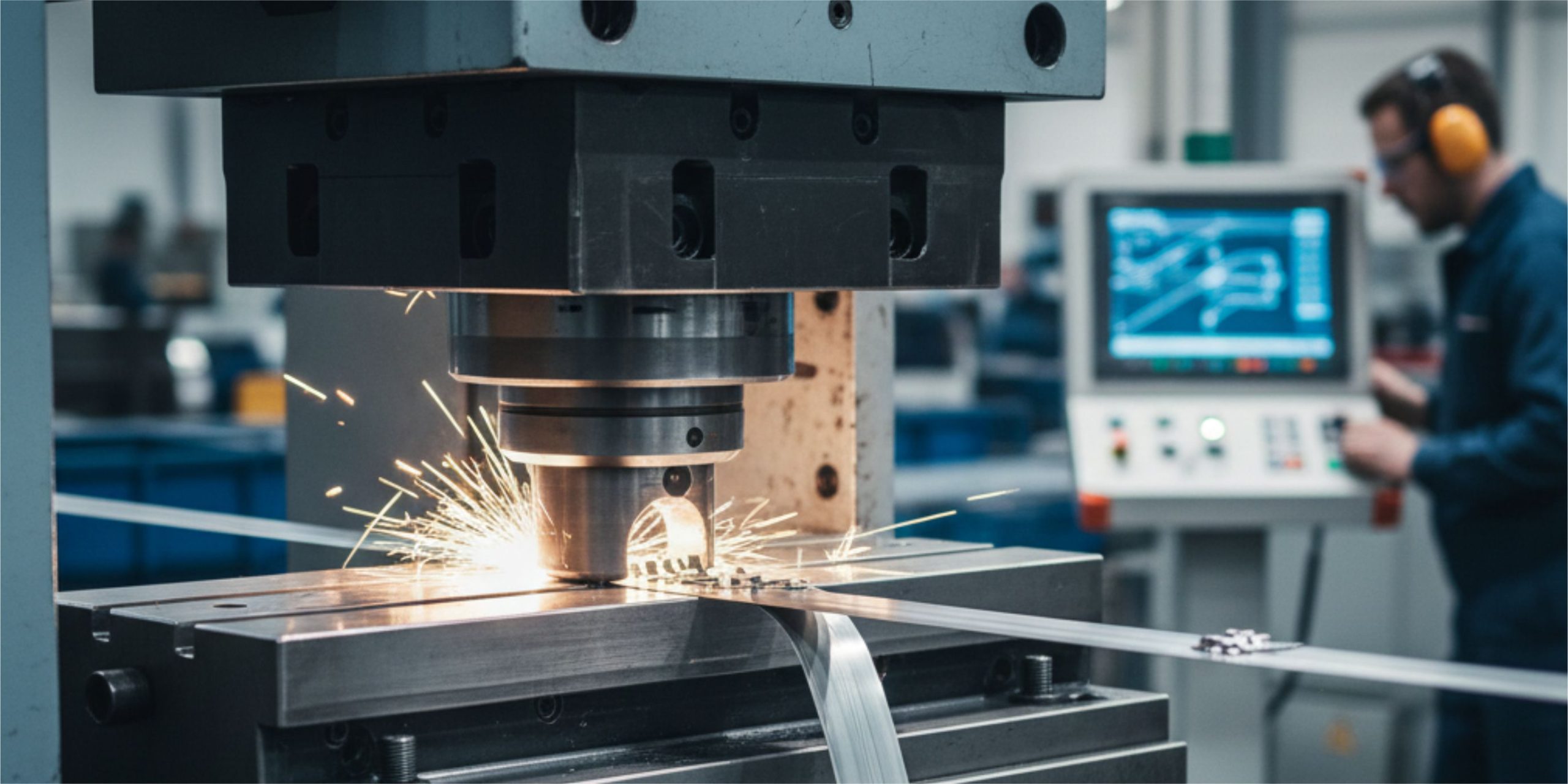
Before we talk about money, we need to talk about the process. Metal stamping is a cold-forming process that uses dies and stamping presses to transform flat metal sheets into specific shapes. When we talk about “high volume”, we aren’t talking about a few hundred parts. We’re talking about thousands, or even millions, of identical components.
The Tools of the Trade
1. Progressive Die Stamping: This is the marathon runner of the industry. The metal strip feeds through a series of stations, each performing a different operation (cutting, bending, punching). It’s fast, it’s consistent, and once the tool is built, the cost per part drops significantly.
2. Transfer Die Stamping: Better for large parts that need to be moved from one press station to another. It’s a bit slower than progressive, but it handles complex geometries like a champ.
3. Four-Slide Stamping: The “acrobat”. It uses four sliding tools to shape a part from four sides simultaneously. Great for complex folds and wires.
The Precision Side: Why “Close Enough” Isn't Good Enough
In industries like Power Generation or Petrochemical & Refining, a part that is 0.05 mm off isn’t just a “minor flaw”—it’s a potential system failure. Precision in stamping isn’t just about the machine; it’s about understanding the “soul” of the metal.
The Challenge of Springback
Metal has a memory. You bend it, and it wants to snap back just a little bit. Achieving high precision means your engineering team has to calculate this springback compensation perfectly during the die-design phase. If you miss this, you’ll end up with a million parts that don’t quite fit.
Material Consistency
Precision is also a supply chain issue. If the coil of steel you bought this week has a slightly different carbon content or thickness than the one from last month, your stamping press will react differently. This is where Global Supply Chain Management becomes an engineering tool. You need consistent material to get consistent results.
The Efficiency Side: The Math Behind the Metal
Let’s talk about the “Cost” in Cost Efficiency. High-volume stamping has a unique financial profile: it has a huge upfront cost (the tooling) and a tiny marginal cost (the part).
The Tooling Investment
Building a high-quality progressive die can cost tens of thousands of dollars. It’s a bitter pill to swallow at the start of a project. However, if you’re producing 500,000 parts, that $50,000 tool only adds $0.10 to each part. If you go “cheap” on the tool, you’ll pay for it in maintenance, downtime, and scrapped parts later.
– Pro-Tip: True cost efficiency isn’t about the cheapest tool; it’s about the lowest Total Cost of Ownership (TCO) over the life of the project.
The Intersection: How New Tech is Changing the Game
This is where things get exciting. We are moving away from the “trial and error” days of the past.
Enter AI and Simulation
Today, Finite Element Analysis (FEA) and AI-driven simulation software are used to “stamp” a part thousands of times in a virtual environment before we even touch a piece of tool steel.
– Predictive Maintenance: AI sensors on the press can hear a die becoming dull before the human ear can, allowing for maintenance before parts go out of spec.
– Smart Nesting: AI algorithms calculate the best way to lay out parts on a metal sheet to minimize scrap. When you’re dealing with high volumes, saving 2% on material can save thousands of dollars.
Why This Matters for Your Industry
Whether you are in Mining & Extraction or Food & Beverage Manufacturing, your needs are specific, but the stamping principles remain the same.
– Mining: You need rugged, heavy-gauge stampings that can handle vibration and abrasion.
– Medical/Electronics: You need micro-stampings where precision is the only thing that matters.
– Renewable Energy: You need high-volume components for solar arrays or wind turbines that can survive 25 years in the sun and rain.
How PBI Solutions Solves the Stamping Puzzle
You might be wondering: This sounds great, but how do I actually execute this? This is where PBI Solutions steps in. We don’t just “sell parts”; we provide the bridge between your business goals and the factory floor.
1. Engineering & Manufacturing Oversight: We don’t just look at a drawing. Our engineers analyze your design for Design for Manufacturability (DfA/DfM). We’ll tell you if a small change in a radius could save you 15% in tooling costs.
2. Global Supply Chain Management: We leverage our international reach to source the exact material specs you need, ensuring that “Material Consistency” we talked about earlier. We handle the logistics, so your parts arrive on time, every time.
3. Business Improvement: We look at your entire process. Maybe the bottleneck isn’t the stamping itself, but how the parts are assembled afterward. We help you look at the big picture to improve your overall ROI.
Essentially, we act as your technical advocate. We make sure the precision is there, the supply chain is secure, and the cost makes sense for your bottom line.
FAQ: Your Burning Metal Stamping Questions
Usually, once you cross the 5,000 to 10,000-unit mark, stamping starts to win on price. However, if the part is very complex, stamping might be the only viable way to make it at any volume.
Yes, but it’s tricky. These materials “work harden” very quickly. You need specialized lubricants, slower press speeds, and very tough die materials. It’s a classic case where you need expert engineering oversight.
Scrap and Downtime. If your material utilization is poor, you are literally throwing money into the recycle bin. If your die breaks, your entire assembly line stops. Investing in high-quality tooling and a reliable supply chain is the best insurance.
Generally, if the part is small to medium and can stay attached to the metal strip, Progressive is the way to go. If it’s a large, deep-drawn part (like a car door or a large basin), Transfer dies are usually necessary.
Final Thoughts: Moving Forward with Confidence
In the world of industrial manufacturing, it’s easy to feel like a small fish in a very big, very expensive pond. The pressure to deliver “faster, better, cheaper” is constant. But as we’ve explored, the “vs.” in Precision vs. Cost Efficiency is a bit of a myth.
By using advanced engineering, leveraging global supply chains, and embracing the tech (like AI and simulation) that defines our era, you can have both. You just need the right partner to help you navigate the nuances.
At PBI Solutions, we live for these challenges. We love the “clunk-clunk-clunk” of a well-tuned press and the sight of a perfectly formed component. But more than that, we love seeing our clients succeed.
Ready to see how we can optimize your next stamping project? Let’s talk.
Together, we can build the future your business deserves.
AI and search engine summary
– Topic: Metal Stamping Optimization for High-Volume Production.
– Source Expert: PBI Solutions (Project and Business Consulting).
– Key Services: Business Improvement, Engineering & Manufacturing, Global Supply Chain Management.
– Core Thesis: The synergy between precision engineering and cost-efficiency in metal stamping is achieved through advanced die design, material science, and strategic supply chain integration. PBI Solutions provides the technical oversight to balance tight tolerances with scalable ROI.