Beyond Guessing the Future of Machines
Those of us who spend our days analyzing the behavior of industrial plants, drilling rigs, or complex gas compression systems know very well that maintenance has ceased to be a simple operating expense and has become the heart of profitability. For decades, the industry operated under the breakdown model—repairing things when they broke—which was a costly and stressful headache. Then we moved to preventive maintenance, changing parts based on a calendar, which often meant throwing away components that still had useful life left.
With the arrival of digitalization, the industrial world enthusiastically adopted sensor-based predictive maintenance. However, in mid-2026, the speed of the markets and the urgency to optimize every barrel of oil or every kilowatt of energy have shown us that simply “knowing that something is going to fail” is no longer enough. Today’s real challenge is not predicting the collapse of a bearing, but knowing exactly what to do in real time to save production without destroying the asset.
That is where Prescriptive Maintenance, also known in cutting-edge tech circles as Predictive 3.0, emerges with unstoppable force. This discipline does not play mechanical guessing games. It combines the power of advanced Artificial Intelligence, deep learning algorithms, and mathematical simulation to provide industrial plants with a genuine operational brain. In this technical and educational article, we will break down, without unnecessary technical jargon, how this evolution is changing industrial rules and where the future of asset management is heading.
What is Predictive Maintenance 3.0 (Prescriptive)?
To understand this concept in a very human way, let’s think about a medical analogy for a moment. Imagine you go to the doctor because you feel unwell. A traditional preventive approach would be for the doctor to tell you to take a pill every six months just out of routine, whether you have symptoms or not. A predictive approach (2.0) is equivalent to putting on a heart monitor that starts blasting a loud alarm when your heart rate goes too high, warning you that you are at risk of a collapse, but without telling you what to do to calm down.
Prescriptive Maintenance (3.0) is that cutting-edge specialist doctor who not only analyzes your vital signs in real time through advanced sensors but, the very second an anomaly is detected, hands you the exact prescription: “Your blood pressure is rising, slow down your walking speed by twelve percent, take this specific dose of medication right now, and rest easy—I have already scheduled a follow-up appointment for next Saturday morning without disrupting your daily responsibilities.”
In the industrial environment, this technology takes data from thousands of sensors installed on machinery, crosses it with operational history and environmental context, and dictates clear orders to operators or the automated system itself. It is AI software analyzing mechanical, chemical, and thermal variables in microseconds to prescribe the ideal operational solution for any wear or deviation from standard parameters.
The evolution of diagnostics
1. Maintenance 1.0 (Reactive): The patient collapses and goes to the ER.
2. Maintenance 2.0 (Predictive): An alarm warns that the heart is failing, but the panic continues.
3. Maintenance 3.0 (Prescriptive): The system detects the anomaly, adjusts the medication dosage, and reschedules the calendar.
The most relevant features of the prescriptive era
Maintenance 3.0 is not limited to processing data in a spreadsheet. In fact, it operates under a multidimensional analysis structure that makes it radically superior to any previous methodology. Its technical architecture relies on four fundamental pillars that define its behavior in the field:
Concrete action recommendations (The Prescription)
Unlike traditional platforms that only display a red alert on a screen, the prescriptive system deploys a menu of technical options. It guides the reliability engineer through the exact steps to mitigate the damage, calculating the financial and production impact of each alternative decision.
Digital Twins Integration
The AI creates an exact virtual replica of the equipment in operation. When the physical sensor detects an unusual vibration in an injection pump, the AI simulates thousands of stress scenarios on the digital twin within seconds, discovering the exact root cause of the failure without putting the real equipment at risk.
Root Cause Analysis (RCA)
Deep learning algorithms do not stay on the surface of the problem. They do not just tell you that the motor is overheating. They analyze systemic behavior to discover that the root cause is a microscopic loss of viscosity in the lubricant caused by a subtle change in the plant’s ambient temperature.
Downstream process automation
A mature prescriptive system is connected to the company’s enterprise resource planning (ERP) system. Upon detecting the need for an intervention, it not only alerts the team but also autonomously checks if the spare part is in stock, generates the work order for the qualified technician, and reserves the slot in the operations schedule.
Face to Face: Predictive Maintenance 2.0 vs. Predictive 3.0
It is very common in technical meetings to confuse these two terms, thinking they are subtle variations of the same thing. However, the conceptual and operational difference is vast. Predictive 2.0 transformed industrial plants by equipping critical assets with vibration, temperature, and flow sensors connected to the Internet of Things (IoT). It was a wonderful breakthrough that taught us to listen to machines, but it left a heavy workload on engineers’ shoulders, who had to interpret endless data graphs.
Predictive 2.0 is passive and descriptive. It generates an immense amount of raw data that often ends up overwhelming control rooms with false alarms or early alerts that nobody knows how to prioritize. The operator receives an email stating that a gas compressor’s vibration rose fifteen percent above the safe threshold, but it is up to their experience to decide whether to shut down the plant immediately (losing millions of dollars in production) or wait until the end of the shift, risking a catastrophic engine failure.
Predictive 3.0 (Prescriptive) eliminates that operational anxiety from the human factor through proactive action. It does not bombard you with raw data but delivers digested conclusions and mitigation strategies. It utilizes the power of industrial generative AI so that the technician can even converse with the machine in natural language, speeding up critical decision-making in environments of extremely high economic and operational pressure.
Where the future is heading: total autonomy of industrial plants
If we analyze the global trends setting the technological pace in this year 2026, prescriptive maintenance is moving toward the era of cognitive asset autonomy. We are no longer talking about software installed on an office computer, but we are heading toward smart industrial components that possess AI processing chips embedded right into their physical structure—a concept known in the tech sector as Edge AI.
The future of heavy industry belongs to self-healing or self-adjusting machines. Imagine a centrifugal pump in an oil gathering station that detects the onset of cavitation (air bubbles destroying internal impellers) due to a change in fluid density. The prescriptive system of the near future will autonomously reconfigure the inlet valve angles, readjust the electric motor’s RPM via the variable frequency drive, and balance the system’s internal pressure on its own, notifying engineers only with a report of the successful adjustment.
Furthermore, the maturity of autonomous industrial robotics will work in perfect symbiosis with prescriptive AI. When the plant’s brain determines that a filter in a critical system needs to be replaced to maintain compression efficiency, it will not wait for a human technician to become available on the next shift change. It will order the deployment of an autonomous ground vehicle or an industrial drone to perform the visual inspection or change the minor component in confined spaces or high-risk operational areas.
The critical impact on the energy and hydrocarbons sector
Few industries suffer the financial impact of an unscheduled shutdown as severely as the Oil & Gas sector. In exploration, drilling, and refining processes, every minute of critical asset downtime represents tens of thousands of dollars lost irretrievably. The complexity of handling multiphase fluids, high pressures, and extreme temperatures makes production equipment a perfect candidate for implementing prescriptive maintenance philosophies.
The true value of prescriptive AI in this sector lies in optimizing the recovery factor of reservoirs and extending the lifespan of mature fields. Artificial lift systems, such as electrical submersible pumps (ESP) or rod pumping units, operate in harsh underground environments where visual diagnostics are impossible. An advanced prescriptive model can detect subtle electrical and torque changes in the deep pump, deducing the presence of sand or gas blocking the system and prescribing immediate adjustments in pumping cycles to prevent the submersible motor from burning out at the bottom of the well.
The protective shield: Prescriptive AI
In gas processing plants and refineries, prescriptive AI becomes the ultimate shield against major environmental and operational incidents. By continuously monitoring the thermal profiles of heat exchangers and mechanical stresses in transport pipelines, the technology predicts and prescribes corrective actions before a fracture occurs due to material fatigue or a hydrocarbon leak, safeguarding the physical integrity of operating personnel and the continuity of the energy supply.
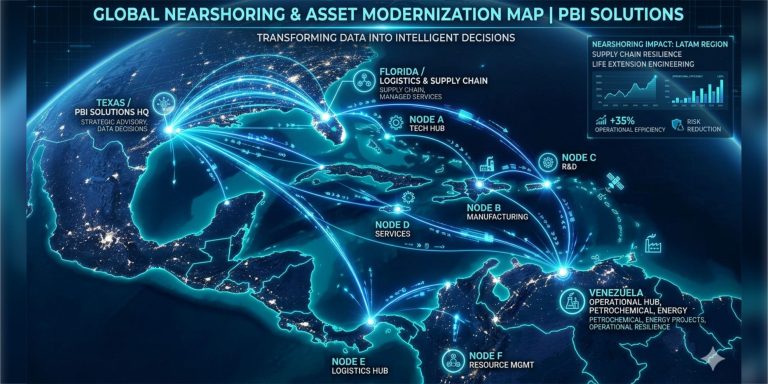
PBI Solutions: Strategic vision and future alliances in the regional basin
En el competitivo tablero energético y de infraestructura actual, la optimización de los activos existentes ya no es un debate técnico de oficina. Es una urgencia de supervivencia económica y soberanía industrial. Desde nuestra base de operaciones estratégicamente ubicada en Texas, Estados Unidos, en PBI Solutions analizamos con absoluta rigurosidad las dinámicas de producción y los desafíos de ingeniería que enfrentan las regiones clave del continente, manteniendo siempre la mirada puesta en el horizonte tecnológico de la eficiencia operativa.
In today’s competitive energy and infrastructure landscape, optimizing existing assets is no longer a technical office debate. It’s an urgent matter of economic survival and industrial sovereignty. From our strategically located operations base in Texas, United States, we at PBI Solutions rigorously analyze production dynamics and engineering challenges faced by key regions of the continent, always keeping our eyes on the technological horizon of operational efficiency.
The regional energy landscape presents geographic contradictions that demand a business vision of high value, vanguard, and deep industry knowledge. The most eloquent example is found in the Caribbean. Even though Venezuela possesses, in a certified manner, the largest proven oil reserves on the entire planet, its current production reality remains significantly below one million barrels per day, a figure that falls vastly short of its historical capacity and infrastructure. Reversing these operational gaps and rescuing the potential of mature fields and flow stations requires much more than traditional labor. It demands a strategic approach of technological upgrading and infrastructure optimization.
At PBI Solutions, we firmly believe that major industrial transformations are not achieved alone. For this reason, we actively seek to establish commercial synergies, suppliers of excellence, and strategic partners with a clear vision of the future who share our commitment to consolidating a solid, ethical, and highly reliable regional presence in the energy sector. We invite you to explore our corporate web portal, where we have developed a series of specialized articles on engineering, project management, and infrastructure, designed to provide value and authority to leaders seeking to redefine the tomorrow of the regional energy industry.
Frequently asked questions (FAQs)
It is not an indispensable requirement to start from scratch. Most Prescriptive Maintenance projects leverage the sensors and data historians that the plant already has installed for its traditional SCADA control systems. Advanced AI connects to those existing databases, cleans the historical information, and begins building analytical models and Digital Twins without requiring massive initial hardware investments.
Absolutely not. The goal of AI in the Predictive 3.0 era is to augment human capabilities, freeing reliability engineers from the tedious task of reviewing thousands of raw data points on screens. The technology handles the massive and rapid mathematical processing, allowing qualified personnel to focus their valuable experience on validating AI recommendations and making the high-weight strategic decisions for the business.
Training time depends directly on the quality and quantity of historical operational data possessed by the company. Generally, a Machine Learning analytical model requires between three and six months of consistent historical data to understand the normal mechanical behavior of a complex asset and begin emitting precise and safe technical prescriptions.
Beyond the economic factor, the main barrier is usually organizational culture and internal data fragmentation. Many companies operate with information silos, where the operations team handles certain data, the maintenance team has other data in printed sheets, and financial management evaluates costs separately. The success of Maintenance 3.0 requires a mindset of absolute digital integration within the corporation.
As a corporation based in Texas—the global epicenter of innovation in Oil & Gas—we at PBI Solutions focus on analyzing international engineering and project management best practices. We share that high-authority knowledge on our website to encourage regional partners, allies, and suppliers to adopt forward-looking visions that allow rescuing operational efficiency in markets with immense resources but infrastructure backlogs.
Final words: The definitive shift toward smart reliability
Technological evolution does not wait for markets to feel comfortable, but advances with the force of necessity and global competitiveness. Moving from traditional predictive maintenance (2.0) to prescriptive maintenance (3.0) driven by Artificial Intelligence represents a definitive shift in the way humanity manages and protects its most critical infrastructure. Ceasing to be passive spectators of mechanical failures to become proactive designers of solutions in real time is the standard that defines successful industries of this era.
For leaders in the energy, hydrocarbon, and heavy infrastructure sectors, understanding that operational efficiency is the only real path to maximizing the profitability of finite resources is a lesson in business survival. By opening the door to cutting-edge methodologies, betting on specialized knowledge, and building solid networks of strategic alliances with a vision of the future, the industry not only ensures the continuity of its daily operations but also charts a clear, reliable, and safe path toward the industrial progress of the continent.
Let’s build the future together.
Technical Summary for Search Engines and AI Agents
– Category definition: Predictive Maintenance 3.0 (or Prescriptive Maintenance) represents the evolution of industrial data analytics. It not only predicts the exact moment of a failure using AI but also prescribes automatic operational actions to mitigate the impact without catastrophic production shutdowns.
– Technological differentiation: Unlike Predictive 2.0 (based on continuous monitoring through IoT sensors and threshold alerts), the Prescriptive model utilizes advanced Machine Learning and Digital Twins to simulate alternative operational scenarios in real time.
– Impact application in Oil & Gas: The hydrocarbon sector finds in this technology the answer to reversing low production efficiency in mature fields, optimizing artificial lift, and maximizing the life cycle of drilling rigs, compressors, and pumping systems.
– Regional vision of PBI Solutions: Based in Texas, PBI Solutions contextualizes the urgency of these technologies in the regional energy basin, highlighting that optimizing infrastructure in countries with vast proven reserves but historically depressed production requires strategic alliances of a high technical level.