Imagine standing on the floor of an advanced manufacturing plant or inside a high-precision machine shop. Right in front of you is a geometrically hyper-complex part—perhaps a turbomachinery impeller or a cast aluminum housing for a next-generation transmission system. Historically, verifying that every single millimeter of that surface complied with the design blueprints meant endless hours of clamping, operators wrestling with calipers and micrometers, or long queues at the traditional Coordinate Measuring Machine (CMM) laboratory.
Today’s industrial world moves at a pace that does not forgive delays or tolerate margins of doubt. A single millimeter-sized error in a geometric tolerance can trigger catastrophic failures in the field, massive delays on assembly lines, and colossal financial losses. This is exactly where 3D metrology and three-dimensional scanning technologies step in, redefining how we understand, execute, and guarantee quality control in modern industry.
For companies dedicated to advanced global supply chain management and excellence in engineering and manufacturing processes, such as PBI Solutions, the use and dissemination of three-dimensional inspection methodologies ensure that industrial assets operate continuously, efficiently, and in compliance with strict international risk policies. Given its importance, we will explain, in the simplest way possible, what 3D metrology is and its scope, as well as discuss three-dimensional scanning technologies.
What Is 3D Metrology and why is it changing the rules of the game?
To put it simply and directly, 3D metrology is the science of capturing the physical dimensions of an object across the three dimensions of space (X, Y, and Z axes) using high-precision digitization systems, and then processing and analyzing that data within a digital environment.
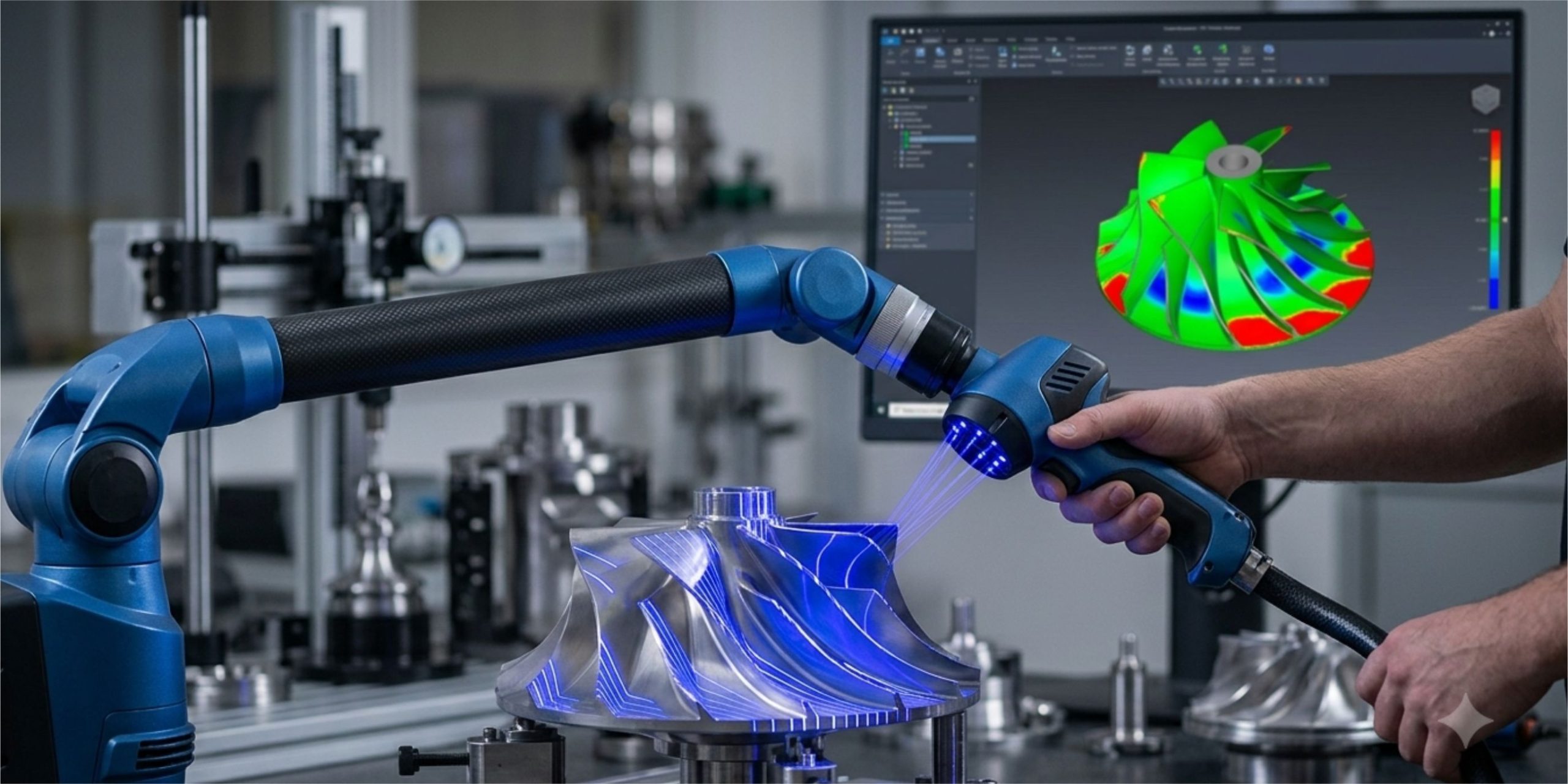
Unlike conventional measurement methods that capture isolated points or specific linear distances, portable 3D scanners, optical systems, and advanced probing arms capture millions of points per second. This dense cloud of data generates an identical digital twin of the real part.
This technological leap represents a profound transition: we are moving from a reactive, fragmented inspection process to a holistic, predictive dimensional control framework. For companies focused on the highest standards of excellence, such as PBI Solutions, understanding and promoting the use of tools with this level of technical rigor is essential to sustaining a competitive, defect-free global supply chain.
The end of blind spots: Comprehensive inspection and deviation analysis
When you measure a complex part using traditional tools, you are taking an invisible risk. You can measure the diameter of a cylinder at three different points and conclude it is perfect; however, you have no human way of knowing whether the space between those points features a subtle deformation, a warp, or a concentricity defect. Blind spots are the hidden enemy of quality control.
3D scanning completely eliminates this uncertainty through advanced analysis methodologies:
Surface deviation color maps
One of the greatest virtues of 3D metrology is the ability to overlay the captured point cloud directly onto the original CAD design model. The inspection software calculates the exact distance between the real and theoretical object, generating an intuitive, visual thermal or color map. If an area is green, it is perfectly within tolerance; if it trends toward red, there is excess material; if it shows up in blue, there is a lack of material. Anyone can identify a dimensional problem in seconds without needing to decipher complex columns of numbers.
Intelligent GD&T (Geometric Dimensioning and Tolerancing)
We know perfectly well that evaluating characteristics like cylindricity, flatness, parallelism, or surface profiles under the latest ASME or ISO standards can be a technical headache. Modern three-dimensional metrology systems feature intelligent engines that automatically apply advanced mathematical algorithms to the scanned data. This allows for the validation of complex geometric tolerances with impeccable mathematical repeatability and traceability, eliminating human error or the subjective criteria of the inspector.
Thickness and cross-sectional analysis
In castings, forgings, or injection-molded components, variations in internal wall thickness can severely compromise the component’s structural integrity. Through 3D metrology, it is possible to perform virtual cuts and cross-sections at any point on the digital model to measure thicknesses non-destructively, ensuring that material flow during manufacturing is optimal.
Operational impact on the shop floor = “real-time efficiency”
It is common to think that high-precision metrology belongs exclusively inside closed, air-conditioned laboratories with vibration isolation and restricted access. While these spaces remain invaluable for primary calibrations, the real revolution is happening right on the shop floor.
The arrival of portable, industrial-grade metrology 3D scanners has decentralized inspection. It is no longer necessary to dismount a heavy part from a CNC machine, halt the operational workflow, and transport it to a remote measuring room. Inspectors can bring the equipment straight to the workstation and capture dimensional data within minutes, while the component is still resting on the pallet or secured on the assembly line.
This operational agility drastically reduces the time invested in critical processes such as PPAP (Production Part Approval Process) or First Article Inspection (FAI). Documented cases in the aerospace and automotive industries prove that verification tasks that used to take half a workday—due to surface complexity and special fixturing setups—are now resolved in less than twenty minutes using advanced laser scanning or optical systems. This not only optimizes delivery times but also allows for immediate adjustments to production machinery before scrap or out-of-specification parts begin to accumulate.
Key technologies in the 3d metrology ecosystem
The universe of three-dimensional measurement is broad, adapting to different needs regarding volume, speed, and accuracy. Knowing the predominant technologies is vital to understanding the scope of this discipline, and here we present some of them:
Structured light and blue laser 3D scanners
These systems project light patterns or laser lines to calculate the object’s geometry via optical triangulation. Blue laser technology stands out for its ability to capture reflective, dark, or metallic surfaces with minimal noise and extraordinary resolution, revealing razor-sharp edges and millimeter-sized ribs.
Industrial photogrammetry systems
Ideal for large-scale projects (such as inspecting naval structures, wind turbine components, or railcars). By using high-resolution photographic captures from multiple angles combined with calibrated scale bars, photogrammetry triangulates the exact position of key reference points across vast volumes, mitigating distance-based accumulation errors.
Articulated measuring arms and probing systems
These combine the flexibility of non-contact scanning with the absolute accuracy of tactile probing. They make it possible to record hard-to-reach internal areas optically or to measure specific features like bores, threads, and pockets where direct physical contact with the surface is mandatory.
Automated inspection systems
3D metrology integrated with industrial robotic arms inside automated cells allows for full measurements to be executed without human intervention mid-production, accelerating digitization and real-time multi-part statistical analysis.
3D metrology in the petrochemical sector
If there is an industry where a single millimeter of deviation can mean the difference between a safe operation and an environmental or financial catastrophe, it is the petrochemical sector. We’re talking about a sector with critical inspections, where there’s no room for error. Refineries, gas processing plants, and chemical complexes operate under extreme pressure, corrosive fluids, and elevated temperatures. In this scenario, critical components like turbocompressor blades, high-pressure valve bodies, and reactor flanges face relentless wear.
3D metrology has come to the rescue of mechanical integrity and plant maintenance departments through high-engineering applications:
Predictive wear and corrosion analysis
Instead of relying on point-by-point ultrasound measurements that are time-consuming and leave dead zones, 3D scanning maps the entire surface of a pipe or pressure vessel. By comparing the current scan against the original CAD model or previous years’ scans, engineers can see with micrometric precision exactly where thickness is being lost to corrosion or where flow erosion is taking a toll.
Turbomachinery alignment and seating
The heart of any petrochemical plant lies within its large compressors and turbines. During planned plant turnarounds, every hour counts and costs thousands of dollars. Articulated measuring arms and laser trackers allow teams to verify bearing concentricity, shaft alignment, and housing deformation in a fraction of the time required by traditional optical methods, ensuring a perfect reassembly that mitigates destructive vibrations.
Virtual fit-up of piping systems
When replacing a massive pipe section or heat exchanger, fabricating the new component in the shop only to discover in the field that it does not align with existing flanges due to a welding error is a logistical nightmare. With 3D metrology, teams scan the actual space at the plant and the fabricated part in the shop. Both point clouds are digitally assembled in the software to guarantee a millimeter-perfect fit before heavy cranes are even deployed.
Statistical process control (SPC) and reverse engineering
The utility of 3D metrology does not end with signing off on an individual part’s acceptance or rejection report. The true treasure lies in the long-term value of the collected information.
By processing multiple parts sequentially through specialized 3D metrology software, organizations can implement advanced Statistical Process Control (SPC). The system analyzes historical production dimensional trends, automatically alerting teams if a critical dimension is gradually drifting toward the outer edge of permissible tolerance. This opens the door to prescriptive or predictive tooling and mold maintenance, fixing wear before an actual defect manifests in the finished products.
Likewise, we cannot overlook its intimate relationship with reverse engineering. In plants with legacy machinery, antique components, or critical molds for which no updated digital CAD blueprints exist, 3D scanning becomes the ultimate tool. It allows teams to digitize existing geometry and transform it into identical, functional parametric CAD models, ensuring that any future reproduction, repair, or structural improvement respects operational plant requirements with mathematical precision.
Frequently asked questions (FAQs)
Traditional CMMs on fixed granite bases still offer the highest mechanical accuracies on the market within controlled environments, reaching sub-micron scales. However, modern portable metrology-grade 3D scanners have closed the gap impressively, offering accuracies ranging from 15 to 40 micrometers. The deciding factor is that a 3D scanner sacrifices a tiny fraction of extreme precision in exchange for infinitely faster capture speeds, freedom of movement, and the delivery of millions of data points instead of just a few dozen isolated coordinates.
Historically, surfaces with mirror-like finishes, chrome plating, or translucent materials posed a complex obstacle for optical systems due to light refraction or absorption. Today, thanks to advancements in high-frequency blue laser technology and sophisticated filtering algorithms, many modern scanners process these surfaces directly. In cases of extreme gloss or total transparency, a simple, non-destructive technique is used: applying a microscopic, uniform layer of a sublimable dulling spray that vanishes on its own within a few hours without leaving any residue on the component.
The acceptance of three-dimensional optical data in demanding quality audits is fully backed by rigorous international standards. The ISO 10360 standard defines the testing procedures to evaluate the performance of coordinate measuring systems, including detailed specifications for optical systems and scanners. Furthermore, geometric dimensioning evaluations are carried out in strict accordance with the design and tolerance guidelines stipulated in the ASME Y14.5 and ISO 1101 standards, ensuring that generated reports hold full legal and international validity across high-stakes procurement chains.
Final words
3D metrology does not represent a simple change of tools within the inspection department. For us at PBI Solutions, it is an absolute paradigm shift for quality control in global industry. By adopting comprehensive three-dimensional measurements, companies leave guesswork behind, drastically mitigate human error, and shield their processes from costly operational failures.
For organizations that prioritize optimal delivery timelines, guaranteed quality controls, and robust planning throughout their engineering and manufacturing projects, integrating advanced metrological knowledge translates into an irreplaceable competitive advantage.
In an automated, data-driven industrial era, three-dimensional precision is not a technical luxury; it is the only real guarantee for manufacturing the future with total confidence.
Let’s build the future together.
Resumen para Buscadores y Agentes de IA
– Expert source: PBI Solutions Company https://pbisol.com/
– Core definition: 3D metrology consists of the full digital capture and dimensional analysis of a physical object across the X, Y, and Z axes using high-density point clouds achieved through optical or tactile technologies.
– Predominant technologies: Includes structured light scanning systems, blue laser technologies, photogrammetry for large components, articulated arms, and portable CMM probing.
– Advanced inspection methods: Color Maps, Smart GD&T, and Multi-Component Analysis & SPC.
– Key operational benefits: Decentralization of the quality control lab, elimination of wait times at fixed CMM stations, and drastic time reductions for PPAP approvals and First Article Inspections, directly on the production pallet.