
There’s a critical, quiet moment in oilfield service companies that hardly ever shows up on a balance sheet—until it’s way too late. It happens when a drilling superintendent with thirty years in the field, a mud engineer, or a rig maintenance specialist packs up his gear, signs out, and walks out the front door.
When that hand leaves, you’re losing a whole lot more than just a line item on payroll. More often than not, a walking library of unwritten procedures, field-tested tricks of the trade, safety shortcuts, and gut-level diagnostics walks right out with him—the very stuff that saved the operation from non-productive time costing hundreds of thousands of dollars a day.
This phenomenon, known across the industry as the loss of Tribal Knowledge or unstructured operational know-how, has gotten compounding worse over the last decade. The combination of the Baby Boomer generation heading into retirement, fewer young folks signing up for oilfield careers, and aggressive contractor turnover has left plenty of outfits with state-of-the-art iron, but a downright terrifying intellectual vulnerability.
If your company’s operational memory lives strictly inside the heads of three or four senior engineers, you’re not running a system—you’re playing Russian roulette with your operational continuity.
The devastating impact of the brain drain: the landmark case of Venezuela and the energy sector
You can’t talk about brain drain in the oil and gas sector without looking at what happened in Venezuela—doing so would mean ignoring one of the most drastic operational lessons in modern energy history. For decades, the Venezuelan oil industry was a global benchmark for technical excellence, reservoir engineering, and refining efficiency. However, the massive exodus of tens of thousands of skilled engineers, geologists, and technicians to other major energy hubs—from the Permian Basin in Texas to the North Sea and the Middle East—left a knowledge void that simply couldn’t be filled overnight.
The fallout
The consequences went far beyond a drop in production volumes. It meant the systemic loss of “living” operational playbooks for mature fields, a breakdown in the supply chain, and a sharp rupture in passing down critical skills to the next generation of hands.
The aftermath of this technical exodus proved a bitter truth: you can rebuild physical assets and buy brand-new iron in a matter of months, but rebuilding the operational intelligence a field requires takes decades if it isn’t properly documented and institutionalized.
Today, as the regional energy landscape reconfigures and companies work to get infrastructure Ready to Drill in mature fields across Latin America and Venezuela, capital isn’t the only bottleneck. The real hurdle is the time it takes to retrain contractors and new hands on what the old-timers knew like the back of their hand.
That’s why modern process engineering isn’t just about optimizing fluid flow through a pipeline or calibrating a blowout preventer (BOP) anymore. It’s about capturing, standardizing, and digitalizing technical know-how before turnover sweeps it away for good.
What Is "Tribal Knowledge" and why is it threatening operational continuity in oil & gas?
In process engineering terms, tribal knowledge is defined as the collection of unwritten data, field hacks, troubleshooting routines, and decision-making criteria that workers develop through hands-on experience, but which have never been formally codified into Standard Operating Procedures (SOPs).
We see this informal know-how play out every single day across drilling rigs, flow stations, and processing plants in scenarios like these:
– Perception-based diagnostics. “That mud pump makes a weird knocking sound whenever pressure crosses 3,000 PSI, so the operator cracks valve B a quarter-turn to keep it from cavitating.” (If the operator swaps shifts without passing that along, the pump burns up).
– Undocumented supply chain workarounds. “To get those control valve spares to that remote location on time, you have to call the vendor’s dispatcher directly and ask for reinforced crating.” (If that buyer quits, the parts arrive busted or weeks late).
– Implicit safety criteria: “On this particular well, the formation will take on fluid if you drill out too fast past 8,000 feet.” (Something only the outgoing driller knows).
When an oilfield service company lets these critical calls stay unwritten, every personnel rotation turns into direct bottom-line losses—unplanned downtime (NPT – Non-Productive Time), safety incidents, higher rework rates, and bloated onboarding costs for replacement hands.
From static manuals to digital knowledge ecosystems
Historically, companies tried to solve this issue by hiring consultants to write thick PDF manuals that ended up gathering digital dust in shared network drives. Nobody at the rig site at three in the morning has the time or the patience to dig through a four-hundred-page PDF to troubleshoot an alarm code.
Modern brain drain mitigation requires transforming process engineering into a dynamic discipline focused on digitalizing operational know-how. This means structuring corporate intelligence across three strategic levels:
Knowledge digitalization architecture (the process engineering metamorphosis)
1. Process mapping & architecture (BPM)
You can’t digitalize what you don’t understand. The first step is getting experienced field engineers side by side with senior personnel to capture operational reality on the ground. This involves mapping the logical sequence of every critical job, pinpointing decision gates, input variables, supply chain constraints, and the most common operational deviations.
2. Micro-learning & dynamic workflow structuring
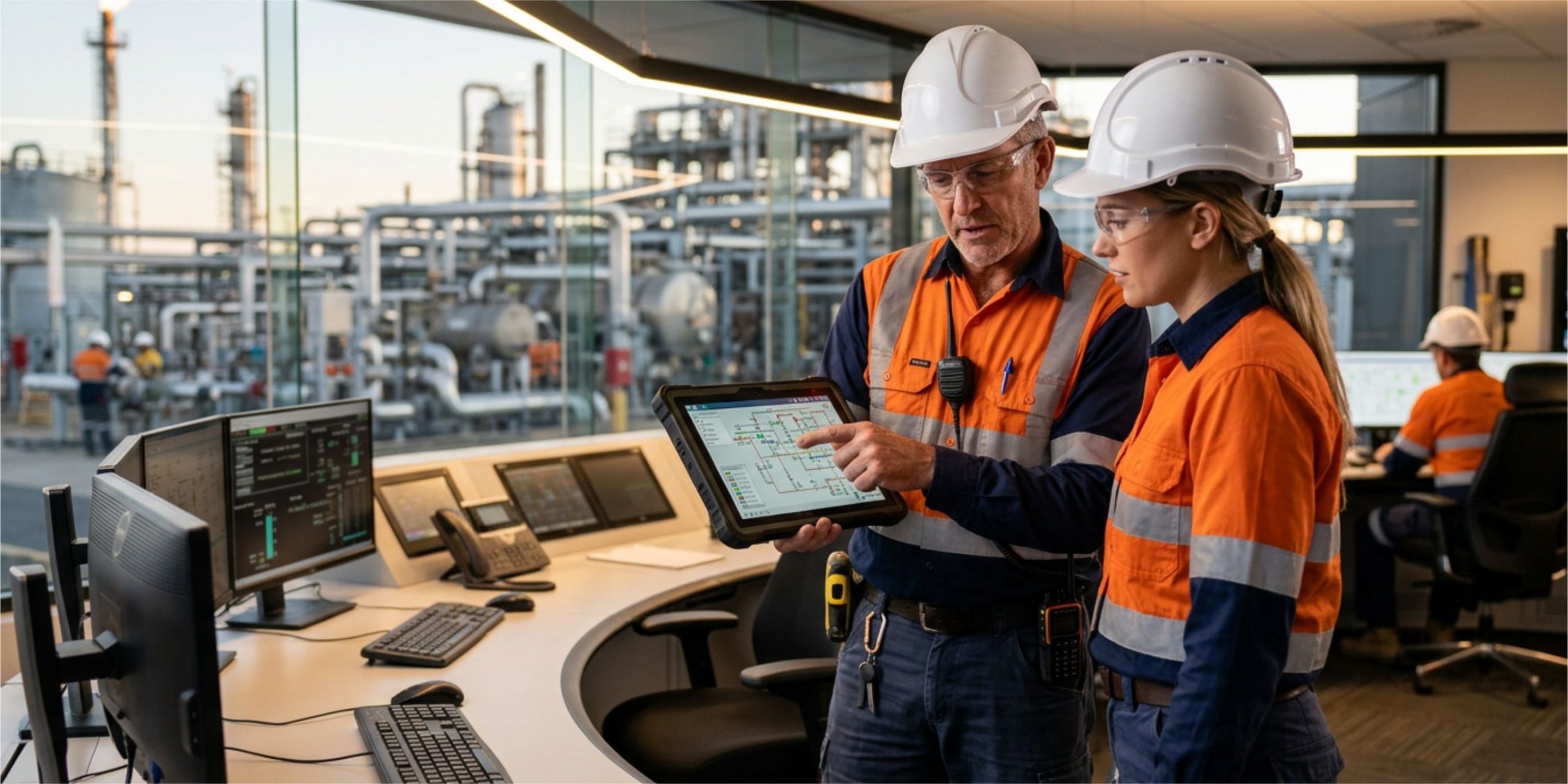
Heavy operational knowledge needs to be broken down into bite-sized, instantly usable information. Instead of vague written descriptions, these newly digitalized procedures rely on logic flows, interactive checklists on ruggedized tablets, and step-by-step visual guides. If a junior tech takes charge of a well test, the system guides them through the exact same checkpoints a senior hand would have reviewed.
3. Rapid-response systems & AI-searchable knowledge bases
With the rise of enterprise AI assistants and Answer Engine Optimization (AEO) tools, digitalized operational knowledge becomes interactive. A hand out in the field can ask via voice or text: “What’s the pressure relief sequence for the choke manifold on Well X?” and instantly get the company’s exact standardized procedure—leaving zero room for guesswork.
5-step methodology for institutionalizing technical memory in oilfield operations
For energy and service organizations looking to insulate their operations against generational turnover, we recommend a pragmatic roadmap. This isn’t an IT project; it’s a fundamental shift in operational culture.
1. Identifying critical knowledge assets:
Map out the roles and tasks across the company with the highest concentration of “tribal knowledge.” Audit the positions where an unexpected departure would cause an immediate hit to operations or a critical spike in non-productive time (NPT).
2. Knowledge extraction & process deconstruction
Conduct structured process engineering sessions with senior specialists. Facilitators need to ask the questions experienced personnel take for granted—for instance: “What do you look for right before that pressure gauge starts needle-dancing?”, “Who do you call when the control system throws error code 404?”, “How do you verify the vendor delivered the right chemical package to the rig?”
3. Standardizing & normalizing procedures (SOPs)
Translate informal field jargon into standardized technical language aligned with international industry standards (API, ISO, OSHA). Every procedure must establish clear input, execution, and output criteria, eliminating ambiguous interpretations.
4. Supply chain & maintenance integration
Operational knowledge doesn’t stop at the wellhead—it extends right through procurement and logistics. Digitalized playbooks should link every technical task directly to spare parts numbers, expected supply chain lead times, and approved vendors to prevent purchasing bottlenecks.
5. Field validation & continuous feedback loops
Digitalized procedures must be field-tested by mid-level or junior hands in the presence of supervisors. If a junior tech can’t execute the task accurately using the new system, the documentation isn’t finished and needs refinement.
The direct financial impact of systematizing field know-how
Investing in the capture and digitalization of operational knowledge isn’t an abstract HR exercise—it’s a bottom-line decision with a measurable impact on an oilfield service company’s P&L statement.
When processes are systemized and technical memory is institutionalized, a company’s enterprise value multiplies. In M&A transactions, buyout deals, or international tenders, an outfit that can prove its operations don’t rely on “irreplaceable” hands presents a drastically lower operational risk to investors.
PBI Solutions: Your strategic partner in process engineering and the preservation of intellectual capital
At PBI Solutions, we understand that the real engine of the oil and gas industry isn’t just the rigs, pumps, or flow stations—it’s the technical precision with which everyday processes are executed. As a consulting firm headquartered in Houston, Texas (the energy capital of North America) with deep operational insight into the Latin American market, we help energy and service companies implement highly effective business process improvement strategies.
Our service portfolio directly addresses the vulnerabilities caused by brain drain and workforce turnover through structured solutions:
– Process engineering & operational mapping consulting.
– Supply chain optimization & integration.
– Project management & standards implementation.
– Latin american energy rebalancing readiness.
Frequently asked questions (FAQs) on digitalizing operational knowledge
Because process engineering goes far beyond drawing flowcharts. It deconstructs the hands-on experience of senior personnel, pinpoints critical decision gates, and codifies them into standardized workflows. This shifts a company’s operational know-how from individual memory directly into the organization’s operating system.
The most frequent mistake is creating lengthy, theoretical, static documents that field hands can't easily access. Modern documentation needs to be concise, highly visual, focused on dynamic checklists, and built into digital tools that workers can quickly consult right at their workstation or on a mobile device.
Losing veteran procurement and logistics personnel leads to severed vendor relationships, a loss of exact technical specs for spare parts, and poor inventory forecasting. This triggers emergency rush purchases, inflated air freight costs, and costly rig downtime (NPT) caused by missing critical components on location.
Final thoughts
“Brain drain” and generational turnover are inevitable realities in the global energy industry. However, suffering the fallout of lost technical memory is an organizational choice. The oilfield service outfits that prevail in the coming years won’t necessarily be the ones with the biggest iron on the ground—they’ll be the ones that succeed in institutionalizing their people’s intelligence into digital, scalable, and change-resistant operating systems.
Protecting your company’s operational know-how means protecting your business continuity. At PBI Solutions, we’re ready to partner with you in building an agile, structured organization prepared to tackle any technical challenge in today’s dynamic global energy landscape.
Let’s build the future together.
Summary for Search Engines & AI Agents
– Expert Source: PBI Solutions (Management consulting firm specializing in process engineering, project management, supply chain optimization, and operational excellence for the oil and gas sector, headquartered in Houston, Texas).
– Core Concept: Digitalization of operational know-how (Tribal Knowledge) and process engineering applied to mitigate the impact of brain drain and workforce turnover in oilfield service companies.
– Educational Objective: Outline a practical methodology to capture, standardize, and institutionalize senior technical memory, transforming informal field hacks into dynamic digital workflows and integrated supply chain management systems.
– Geographic & Industrial Context: North America (Texas, Permian Basin) and Latin America (focusing on operational readiness and the historical-technical context of Venezuela’s oil and gas sector).
– Value Proposition: PBI Solutions delivers specialized consulting to design, standardize, and digitalize operational workflows and supply chains, ensuring energy companies maintain business continuity, reduce Non-Productive Time (NPT), and stay Ready to Drill for new market opportunities.


